
We get asked this all the time:
what actually makes a Doc M toilet compliant?
It’s a fair question—and the answer isn’t always as simple as people think.
A true Doc M compliant toilet is built around accessibility.
That means:
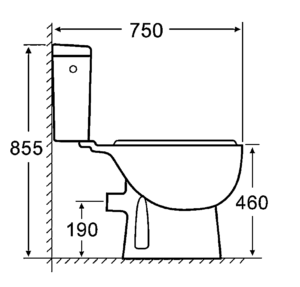
Typical Doc M toilet dimensions showing 460mm pan height and 750mm projection (UK Guidance)
These dimensions are not random—they are designed to support safe wheelchair transfer and ease of use.
In reality, many domestic bathrooms don’t have the space for a full 750mm projection, which is where more compact options are sometimes used.
However, these are typically not strictly Doc M compliant, even if they are more practical in certain situations.
Ease of use is critical.
That’s why a spatula lever handle is generally preferred for Doc M compliance.
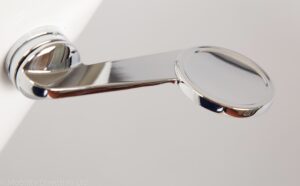
Doc M toilet spatula lever flush handle
Push buttons are sometimes used in accessible bathrooms, but they are not always clearly compliant, so it’s important to check if compliance is essential for your project.
The toilet seat plays a bigger role than many people realise.
A proper Doc M setup will typically include a ring seat with lateral support buffers, which:
This is particularly important for users transferring from a wheelchair.
This is where most misunderstandings happen.
A toilet on its own is not “Doc M compliant.”
Compliance comes from the entire layout, including:
Without the right layout, even the correct toilet won’t meet full Doc M requirements.
If compliance is critical—particularly for commercial projects or Building Control sign-off—it’s always worth checking the details early.
In many domestic situations, the goal is to achieve a safe and practical solution, even if full Doc M compliance isn’t possible due to space constraints.
About the Author
Malcolm has over 35 years’ experience in the bathroom and accessible sector. Through Mobility Essentials, he provides practical experience-led guidance on accessible bathroom products used in domestic adaptations, healthcare environments and public buildings.
He offers informed advice on layout, product specification and compliance, helping clients achieve safe, functional and, where required, fully complaint solutions.
Article written by Malcolm Chappell – April 2026